What are agglomeration and granulation ? PDF Print E-mail

AGGLOMERATION

The process of particle size enlargement in which small,
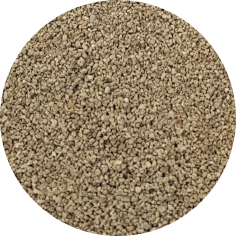
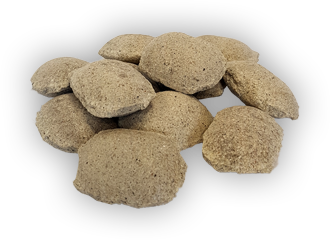
fine particles (such as dusts or powders) are gathered into larger masses, briquettes or granules
with the use of pressure, agitation, heat...

GRANULATION

The formation of small particles called granules by growth agitation (pelletizing);
the term also refers to the size reduction processes of milling and grinding.
 
PDF Print E-mail

The main objectives behind the agglomeration of powders are:

  • Shaping the fines
  • Process dedusting fines in order to obtain a densified and eventually inertized product
  • Create an homogeneous mix of several components
  • Improve the appearance of a consumer good and its handling characteristics
  • Improve flowability in silos, hoppers, etc...
  • Increase the bulk density by coefficients ranging from 2 to 10
  • Control the solubility
  • Improve the chemical, energetical, metallurgical efficiency of the raw materail
  • Improve handling properties for an easier transport, storage or collection of the raw material
 
PDF Print E-mail
The different agglomeration processes

The usual classification of agglomeration processes generally specifies 2 types of processes :

  • Processes using agitation or growth of particles (without application of external forces)
  • Processes using pressure (application of external forces - weak, average or high)

And two types of techniques :

  • agglomeration without binder
  • agglomeration with binder.

A. Processes using agitation or particle growth

In these processes, adhesion between particles is caused by the addition of liquid binders or water and the probability of collision between these particles at variable concentrations in an agitating device.

Such operating conditions can be obtained in the following equipment :

  • Disc pelletizers
  • Rotating drums
  • Special mixers (plough share type, pin type...)
  • Fluidized beds.
In most cases, these processes enable to obtain "green" agglomerates with the growth of nuclei in more or less spherical "aggregates".They are formed thanks to the capillary forces generated by the liquid addition.

It is possible that one or several elements of the agglomerates produced brings them some strength but in most cases, one or several of the following steps must be applied after agglomeration :

  • Drying
  • Cooling
  • Screening / sizing
  • Conditioning (polishing / coating…)
  • Recirculation of fines


B. Processes using pressure

Low and medium pressure :


Particles mixed with this binder or water can be for example extruded through dies from various shape and design. Agglomeration is realized forcing the mass of particles in the die holes and with the help of friction forces.

Following the plasticity of the raw materials, different quality and types of agglomerates can be used.

High pressure :

Hydraulic and piston presses are particularly adapted to highly elastic raw materials. These equipments enable to use wider range of particle sizes. However, the admissible moisture level is limited in these processes.

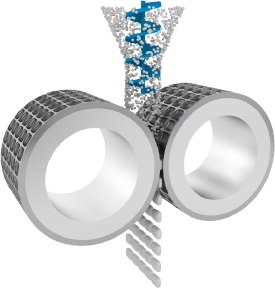
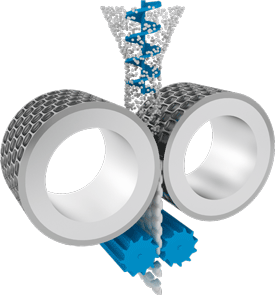
Roller-press or compactors are often used for low elasticity, relatively dry materials, with or without binders.
Agglomerates produced with this technique can generally be handled easily and present a significant mechanical strength at the outlet of the agglomeration equipment. In some cases, to improve this strength, an addition of binder or a post-treatment of the agglomerates (briquettes, granules) has to be carried out.

Densification and process limits in pressure agglomeration :

The mechanism of densification taking place during these processes using pressure includes the following steps :

  • A rearrangement of particles between them (low pressure phase)
  • A quick pressure increase during which the weak particles are broken and the plastic particles are deformed.

Two phenomena can limit the agglomeration process :

  • The " spring effect " of compressed particles
  • The air volume compressed between the particles.

These two phenomena can cause breakages, weaken the agglomerates or even destroy them.

In most cases, entrapment of air can be avoided if the densification occurs slowly to enable the air contained in the decreasing porosity to escape from the raw material and the agglomeration equipment.
This problem is particularly acute and increased with the smaller sizes of the particles. The problem of "spring effect" can only be solved maintaining the maximum pressure during some time. This is only feasible in hydraulic/piston presses in which briquettes are formed in a pressure chamber.

Roller-press do not offer this solution due to a short compression time, generally lower than 0.5 second. However, they can be built for larger capacities (up to 100 T/h in some applications against a few tonnes per hour for hydraulic presses).

 
PDF Print E-mail

The following information will enable us to propose the optimum technical solution to agglomerate or granulate your fines.

A. Raw material characteristics

  • Size-range
  • Moisture level
  • Abrasivity / hardness
  • High or low temperature
  • Elasticity.

B. Agglomerate characteristics

  • Size-range / shape
  • Dispersibility, density
  • Mechanical strength and / or end-use of the briquettes.

C. Process characteristics

  • Possibility to use an additive (water, binder, lubricant...)
  • Energy consumption
  • Energy consumption/li>
  • Admissible financial investment level..
 
PDF Print E-mail
Range of presses / compactors

Our range of presses / compactors is designed according to :

  • Total load on the moulding rolls : these loads are generally located between 50 and 7000 kN from the lab press to the largest compactor operating on potash. The total load equals the specific load in kN/cm linear multiplied by the roll width in cm.
  • Capacity : the smallest units have a capacity of 10-30 kg/h. The largest exceed 100 T/h,articularly when compacted sheets are produced. Each category of raw material processed has a limit in terms of unit capacity per press or compactor due to the raw material characteristics themselves, the design of the press/compactor (feed system, roller bearing size etc...)
  • Feed system :Gravity or screw feeder can be used. Force-feeder can be vertical or horizontal.
  • Power / torque installed for roll drive : they vary between 2 and 800 kW. Weights of presses can therefore vary between 500 kg and more than 100 tonnes.


Last news

January 2009 : K.R KOMAREK moves to neew facility in Wood Dale (Illinois)
June 2009 : New pilot type DH 400 in Quievrechain
New RUF 11/1600/80 press for wood chips industrially compacted in cylindrical briquettes for automatic feeding of boilers.